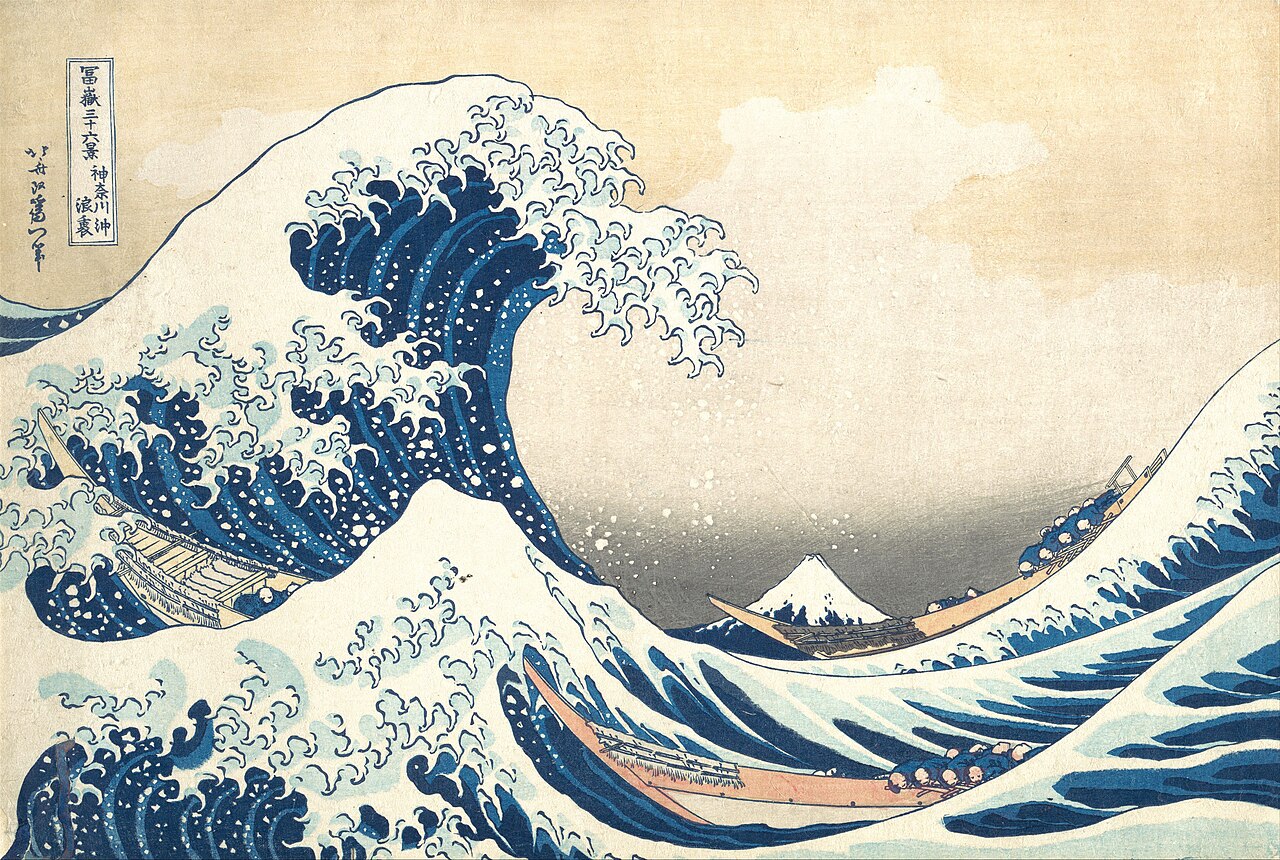
The Great Wave off Kanagawa by Katsushika Hokusai

All Is Well in the Great Mess

"That which I have said is only like the few leaves in my hand. And that which I have not said is like the dry leaves in this forest."

50,957 words

Past Authoring / Autobiography - 06 - Instructions 5

Sleeping

It may be best to do this exercise, as well as the present and future authoring exercises, over several days. The research done on the relationship between writing and mental and physical health has demonstrated that sleeping and, more particularly, dreaming, can help you participate more deeply in the writing exercise and consolidate your new ideas.

So take your time and let yourself get deeply into the exercise.

Permalink

Past Authoring / Autobiography - 05 - Instructions 4

Writing

Why write? Writing is a sophisticated form of thinking. Thinking prepares you to perceive properly and act intelligently. If you don’t think things through, particularly difficult things, then you are likely to make serious mistakes and to hurt yourself and other people. When you write about personally important matters, you can start to identify the causes of events that might hurt and damage you. You can begin to understand how you might have to change the way you see and think to avoid unnecessary pain and suffering.

Read post

Past Authoring / Autobiography - 04 - Instructions 3

Memory, Emotion and Stress

Your mind is always trying to determine the level of danger presented by your environment. When bad things happen to you, your mind and your body react by treating the environment as if it is dangerous, and preparing for emergency action. This preparation is stressful, and depletes you, mentally and physically.

If something bad has happened to you, in the past, your mind cannot be at peace until you have figured out how to avoid having the same thing happen to you again in the future. You can tell how well you have managed this by remembering different important events from the past. If you recall memories that make you feel ashamed, or guilty, or angry, or hurt, and these memories are more than a year and a half old, then your mind is not at peace, and you are still carrying the weight of your past.

Read post

Past Authoring / Autobiography - 03 - Instructions 2

Completing the Exercise 2

On many pages, you will not be able to successfully click Next or Previous unless you have provided a minimum of necessary text. If you do not, you will receive an error message, and the text box in question will be highlighted in red.

Text boxes also have a maximum length. Pay attention, as you write, to the numbers above the text boxes. Numbers like [180 / 1000] indicate that you have typed 180 characters out of a maximum allowable of 1000. When you go over the maximum, the numbers above the text box become red. Clicking Next, Previous, or Save will result in an error message and you will not be able to proceed to the Next or Previous page. To resolve this, edit your text until the number of characters is less than or equal to the maximum. These limitations have been established so that you do not get stalled at any point in the process.

Read post

Past Authoring / Autobiography - 02 - Instructions 1

Completing the Exercise 1

Welcome to the Past Authoring (Autobiography) component of the self-authoring suite. This exercise is designed to help you develop a clearer sense of your past, by writing your own story. Understanding the defining moments of your life can help to illuminate your present situation, and make it easier to plan and determine your future direction.

During this exercise, you will be presented with a series of pages, providing information, or asking you to define and describe different periods or epochs of your life, and the experiences you had during those epochs.

Read post

Past Authoring / Autobiography - 01

Welcome to the Past Authoring / Autobiography component of the Self-Authoring suite. This exercise is designed to help you develop a clearer sense of your past, by writing your own story.

The exercise may take up to four hours to complete. You may quit the exercise any time by clicking Exit/Home or shutting down your browser. If the current page is a page you have been writing on, remember to click Save before exiting. The text that you entered on previous pages will have already been saved.

Read post

Marcus Aurelius - Meditations - Book 4

Book 4

1. Our inward power, when it obeys nature, reacts to events
by accommodating itself to what it faces—to what is
possible. It needs no specific material. It pursues its own
aims as circumstances allow; it turns obstacles into fuel. As
a fire overwhelms what would have quenched a lamp.
What’s thrown on top of the conflagration is absorbed,
consumed by it—and makes it burn still higher.

2. No random actions, none not based on underlying
principles.

Read post

Marcus Aurelius - Meditations - Book 3

Book 3

IN CARNUNTUM

1. Not just that every day more of our life is used up and less
and less of it is left, but this too: if we live longer, can we be
sure our mind will still be up to understanding the world—to
the contemplation that aims at divine and human knowledge?
If our mind starts to wander, we’ll still go on breathing, go
on eating, imagining things, feeling urges and so on. But
getting the most out of ourselves, calculating where our duty
lies, analyzing what we hear and see, deciding whether it’s
time to call it quits—all the things you need a healthy mind
for . . . all those are gone.

Read post

Keeping a Stoic Journal

I have experimented with other exercises, but journaling is my primary Stoic exercise, although I journal a variety of ways.

One of the better starting points (not historically Stoic, but influenced by Stoicism) is the philosophical meditation routine from the The Philosopher’s Mail , although I personally bring more Stoic elements into it by, in addition to the questions listed there, I ask what the different experiences say about what I value, whether these values concern virtues/vices or externals, and what virtues and vices do apply.

Read post

F.A.Q.

In what order should I write the programs?

Our users each have their own experiences, circumstances, and needs. Some people benefit from doing the Past Authoring exercise first. One approach is to do the Present Authoring Faults exercise first, to sharpen your sense of self criticism, the Future Authoring exercise next, to formulate a plan, then the Present Authoring Virtues exercise, to think about capitalizing on your strengths, and finally the Past Authoring exercise. However, if you have significant issues in your past that are still causing you some trouble, you might consider starting with the Past Authoring exercise. You should do it in the order that you think will benefit you the most.

Read post

Excercises

  1. Future Authoring
  2. Present Authoring - Virtues
  3. Past Authoring
  4. Present Authoring - Faults
Permalink

Epictetus - The Enchiridion

HANDBOOK

1.1. Some things are within our power, while others are not. Within our
power are opinion, motivation, desire, aversion, and, in a word,
whatever is of our own doing; not within our power are our body, our
property, reputation, office, and, in a word, whatever is not of our
own doing.

  1. The things that are within our power are by nature free,
    and immune to hindrance and obstruction, while those that are not
    within our power are weak, slavish, subject to hindrance, and not our
    own.

Read post

Bleiben will ich, wo ich nie gewesen bin

Was ich habe, will ich nicht verlieren, aber
wo ich bin, will ich nicht bleiben, aber
die ich liebe, will ich nicht verlassen, aber
die ich kenne, will ich nicht mehr sehen, aber
wo ich lebe, da will ich nicht sterben, aber
wo ich sterbe, da will ich nicht hin:
Bleiben will ich, wo ich nie gewesen bin.

Thomas Barsch

Permalink

Wer noch grün ist, kann wachsen.
Wer sich bereits reif wähnt, beginnt schon zu faulen.

René Borbonus

Permalink

“The wise man is consistent in both his thoughts and actions.”
Donald Robertson, How to think like a Roman emperor</b

Permalink

“Just keep in mind: the more we value things outside our control, the less control we have.”

Epictetus

Permalink

“We are what we repeatedly do. Excellence then, is not an act, but a habit.”
Aristotle

Permalink

About Stoically Braving the Odds to Emerge Stronger

Want to build-up resilience and will power? The stoics offer a daily dose of subjecting yourselves to the worst-case scenarios to your troubles. It’s a simple methodology where you focus on yourself and your immediate surroundings once the terrible event has befallen you. According to the stoics, factoring every tragedy in one’s life trajectory is key to letting nothing disturb your internal peace.

Here’s the vision of a stoic on the journey through Covid-19.

Permalink

Everyday, think as you wake up, ‘today I am fortunate to have woken up, I am alive, I have a precious human life, I am not going to waste it. I am going to use all my energies to develop myself, to expand my heart out to others, to achieve enlightenment for the benefit of all beings, I am going to have kind thoughts towards others, I am not going to get angry or think badly about others, I am going to benefit others as much as I can.
Dalai Lama

Read post

In everything that you do, pause and ask yourself if death is a dreadful thing because it deprives you of this.

Marcus Aurelius

Permalink